
How to Grow a YouTube Channel: Get More Views and Subscribers
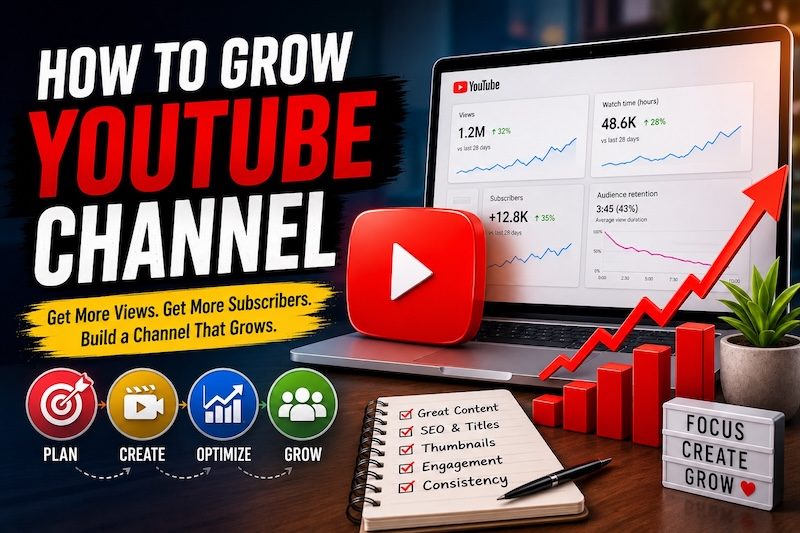
Growing a YouTube channel takes more than uploading videos and waiting for viewers. A channel grows when its videos reach the right people, earn a click, hold attention, and lead viewers to another video.
You do not need expensive equipment or daily uploads to make progress. You need a clear topic, useful videos, strong packaging, and a repeatable way to learn from each upload.
1. Give the Channel One Clear Purpose
A new visitor should understand the channel within a few seconds. The channel name, banner, description, thumbnails, and recent uploads should point toward the same type of viewer.
A broad subject does not provide enough direction. “Technology” could cover phones, programming, artificial intelligence, gaming equipment, repairs, or business software. Choose a more specific promise.
- Too broad: Fitness videos
- Clearer: Home strength workouts for busy parents
- Too broad: Cooking
- Clearer: Simple Indian meals for beginners
- Too broad: Personal finance
- Clearer: Money guides for people starting their first job
A clear focus helps YouTube understand which viewers may enjoy the content. It also gives viewers a reason to subscribe. They know what future uploads will offer.
Write a one-sentence channel promise
This channel helps [specific viewer] achieve [specific result] through [type of videos].
For example: “This channel helps first-time YouTube creators make clearer videos with simple filming, editing, and thumbnail guides.”
2. Build Three Content Pillars
Content pillars are the main groups of topics covered by a channel. Three pillars usually provide enough variety without making the channel feel random.
A channel about home gardening could use these pillars:
- Growing vegetables in small spaces
- Fixing common plant problems
- Choosing soil, pots, seeds, and tools
Each pillar should serve the same viewer. Avoid adding an unrelated subject because one video idea looks popular. Random uploads may attract people who never watch anything else on the channel.
Turn each pillar into a list of common problems, mistakes, comparisons, and goals. That list becomes the starting point for future videos.
3. Find Topics People Already Want
A well-edited video can still fail when few people care about its subject. Topic choice often matters more than camera quality.
Use several sources to find useful ideas:
- Type a phrase into YouTube search and study the suggested completions.
- Read comments under popular videos in the same field.
- Look for questions that creators answered poorly or left unanswered.
- Check search terms in YouTube Analytics after the channel gains traffic.
- Study which subjects bring repeat views to similar channels.
- Collect questions from customers, students, community groups, and forums.
Do not copy another creator’s script, title, or thumbnail. Study the viewer need behind the successful video. Create a clearer angle, a newer example, a simpler method, or a more useful demonstration.
Use the problem, result, and angle method
Viewer problem + desired result + specific angle = focused video idea
Example:
- Problem: Indoor videos look dark.
- Result: Brighter footage.
- Angle: Use one affordable light in a small room.
- Video idea: How to Light a YouTube Video With One Cheap Light
4. Plan the Title Before Filming
A title forces the creator to define the promise. Planning it first prevents the video from becoming a loose collection of ideas.
A useful title tells the viewer what the video covers and why it matters. Keep the main words near the beginning. Remove words that do not change the meaning.
Simple title formats
- How to achieve a result: How to Record Clear Audio in a Noisy Room
- Specific list: 7 YouTube Mistakes That Reduce Watch Time
- Comparison: Phone Camera vs Mirrorless Camera for YouTube
- Test or result: I Posted One Short Every Day for 30 Days
- Beginner guide: YouTube Thumbnails for Beginners
- Problem fix: Why Your YouTube Videos Look Blurry After Uploading
Avoid titles that promise something the video does not deliver. A misleading title may gain clicks but lose viewers during the opening. That weakens trust and limits repeat viewing.
5. Design a Thumbnail Around One Idea
A thumbnail should communicate before the viewer reads every word in the title. Small details disappear on phones. Use one main subject and one clear visual message.
Strong thumbnails often include:
- A clear face, object, result, or comparison
- Enough contrast to separate the subject from its surroundings
- Little or no text
- Large shapes that remain clear at a small size
- A visual detail that adds information not already stated in the title
Do not turn the thumbnail into a poster. Five screenshots, several arrows, tiny labels, and long sentences make the message harder to understand.
The title and thumbnail should work together. A title may state the problem while the thumbnail shows the result.
Title: I Fixed My Dark YouTube Videos With One Light
Thumbnail: A simple dark-versus-bright face comparison with the light visible between both sides.
Use YouTube Studio’s title and thumbnail testing tools when they appear in your account. Test meaningful differences rather than changing one small shade or moving the same text slightly.
6. Win the First 30 Seconds
Many viewers decide whether to stay during the opening. Do not begin with a long logo animation, an unrelated story, or a full channel introduction.
The opening should confirm the title and thumbnail. Show viewers that they chose the right video.
- State the problem: Name the exact issue the viewer wants to solve.
- Show the result: Display the finished outcome when possible.
- Explain the path: Tell viewers what the video will cover.
- Start delivering: Move into the first useful step.
For a tutorial about fixing poor microphone sound, play a short before-and-after example near the beginning. The viewer hears the value instead of waiting for an explanation.
7. Structure Videos to Hold Attention
Audience retention measures how well each part of a video keeps viewers watching. A sharp drop often points to a slow section, a confusing explanation, or a broken promise.
Give every section a job. Remove parts that do not help the viewer reach the promised result.
A useful video structure
- Confirm the problem and result.
- Explain what the viewer needs before starting.
- Present the steps in a clear order.
- Show an example after each important idea.
- Address a common mistake before it happens.
- Show the finished result.
- Recommend the next related video.
Change the visual when the viewer needs more information. Use screen recordings, close-ups, diagrams, examples, captions, or camera changes. Do not add movement only to make the screen busy.
8. Create Videos That Lead to More Videos
A single helpful upload can earn views. A connected group of videos can grow a channel.
Plan small series around the same goal. A beginner photography channel could publish:
- Camera Settings for Indoor Photos
- How to Use Window Light
- How to Avoid Blurry Handheld Photos
- Simple Photo Editing for Beginners
Each video should stand on its own. It should also create a natural next step. Add the related video to an end screen, playlist, card, description, or pinned comment where appropriate.
Do not finish by recommending five unrelated uploads. Choose one next video that solves the viewer’s next likely problem.
9. Balance Search Videos and Recommendation Videos
YouTube Search serves viewers who already know what they need. Home and suggested recommendations reach people based on their viewing interests.
Search-focused videos often answer direct questions:
- How to remove background noise in CapCut
- How to transfer photos from an iPhone to a Mac
- How to create a YouTube channel banner
Recommendation-focused videos often use a strong situation, result, experiment, or story:
- I Edited Every Video on My Phone for One Month
- I Replaced My Expensive Camera With an iPhone
- The Upload Mistake That Hurt My Small Channel
A new channel can start with clear search topics to solve known problems. Add broader recommendation ideas after learning which subjects attract the right viewers.
10. Use YouTube SEO Without Stuffing Keywords
YouTube search optimization helps the platform understand the subject of a video. It does not require repeating the same phrase in every sentence.
Choose one main search phrase and one or two close variations. Use them where they fit naturally:
- Place the main phrase in the title when it matches the video.
- Explain the subject in the first lines of the description.
- Use clear chapter names for long videos.
- Say the important terms while explaining the topic.
- Add accurate captions or correct automatic captions.
Write the description for the viewer. Explain what the video covers, who it helps, and what tools or steps it includes. Do not fill it with blocks of repeated keywords.
Tags play a limited role for most videos. Use them for useful spelling variations, alternate names, or terms that viewers often misspell. Spend more time improving the topic, title, thumbnail, and video.
11. Use Shorts With a Clear Purpose
Shorts can introduce the channel to new viewers. They work best when they support the same topic as the main content.
A cooking channel should not post unrelated comedy clips only because those clips may gain views. Those viewers may never watch the recipes that the channel wants to grow.
Use Shorts to:
- Share one quick result from a longer guide
- Answer a narrow question
- Test interest in a new subject
- Show a before-and-after example
- Turn one useful moment from a long video into a separate lesson
Start the Short with the action, problem, or result. Remove greetings and setup that viewers do not need.
12. Publish at a Pace You Can Maintain
Consistency matters because viewers need repeated chances to discover the channel. Consistency does not require daily uploads.
Choose a schedule that protects quality. One useful video each week can outperform several rushed uploads. A complex documentary channel may need more time. A simple tutorial channel may publish more often.
Create a basic production system:
- Collect ideas throughout the week.
- Choose the title and thumbnail idea.
- Write a short outline.
- Record several videos or sections together.
- Edit with a repeatable checklist.
- Schedule the upload.
- Review the results after enough data arrives.
A fixed process reduces the effort needed to start each video.
13. Ask for Engagement at the Right Moment
A request to subscribe works better after the video proves its value. A generic request during the first few seconds gives new viewers no reason to act.
Connect the request to a clear benefit:
“Subscribe for weekly guides about filming clear videos with affordable equipment.”
Ask focused questions instead of saying, “Leave a comment.” A specific prompt produces more useful responses.
- Which of these three microphone settings improved your audio?
- Which editing program should the next guide cover?
- What part of the setup caused the most trouble?
Comments can reveal future video ideas. They also show which explanations viewers found unclear.
14. Learn From YouTube Analytics
YouTube Analytics shows where viewers found a video, whether they clicked, how long they stayed, and whether they returned.
Do not judge a video from views alone. A smaller video may attract more suitable viewers and lead to more subscribers or follow-up views.
| Metric | What It Shows | What to Check |
|---|---|---|
| Impressions | How often YouTube showed the thumbnail in eligible locations | Whether the topic is receiving opportunities to reach viewers |
| Click-through rate | How often an impression led to a view | The strength and accuracy of the title and thumbnail |
| Audience retention | Where people continued watching or left | Slow openings, confusing sections, repeated points, and strong moments |
| Average view duration | The average time watched | Whether viewers received enough value to remain |
| Traffic sources | Where viewers found the video | Search, suggested videos, Home, Shorts, external sites, or advertising |
| Subscribers gained | How many viewers subscribed after watching | Which subjects attract people who want more content |
| Returning viewers | How many people came back to watch again | Whether the channel is building a regular audience |
| End-screen clicks | How often viewers chose the recommended next video | Whether the next-video suggestion matches their interest |
Compare videos with similar formats and lengths. A five-minute tutorial and a forty-minute interview serve different viewing habits. One universal benchmark will not explain both.
Use a simple review routine
Check each upload after it has collected useful data. Answer four questions:
- Did YouTube show the video to viewers?
- Did the title and thumbnail earn clicks?
- Did the opening keep the right viewers?
- Did viewers continue to another video or return later?
Change one major part at a time. A complete title and thumbnail redesign makes sense when impressions are strong but clicks remain weak. A new thumbnail cannot repair a video that loses most viewers after an unclear opening.
15. Improve Videos That Already Have Potential
Old uploads can keep bringing traffic. Review videos that receive impressions but attract fewer clicks than similar content.
Possible improvements include:
- Replacing an unclear thumbnail
- Shortening a vague title
- Moving important words closer to the beginning
- Updating an outdated description
- Adding chapters to a long guide
- Adding a relevant end screen
- Linking a newer and more complete follow-up video
Do not change a title only because the video slowed down for a day. Study a longer period and compare it with similar uploads.
16. Turn Winning Topics Into Series
A successful video gives evidence about viewer interest. Build on the subject instead of moving to something unrelated.
Suppose “How to Make Clear Voice-Overs at Home” performs well. Follow-up ideas could include:
- Best Microphone Position for Voice-Overs
- How to Reduce Room Echo Without Foam Panels
- Free Voice-Over Editing Settings
- USB Microphone vs Phone Microphone
- Five Voice-Over Mistakes Beginners Make
The follow-up should answer a different need. Do not remake the same video with a slightly changed title.
17. Collaborate With Channels That Share Your Audience
A useful collaboration introduces the channel to people who already care about the subject. Choose creators based on audience fit rather than subscriber count alone.
A home workout creator could collaborate with a physiotherapist, nutrition educator, running coach, or fitness equipment reviewer. Each creator serves a related need.
Plan a real video idea before contacting someone. A message that only asks for “a collaboration” creates more work for the recipient.
Include:
- The proposed video topic
- Why it fits both audiences
- What each creator will contribute
- The expected recording format
- A realistic publishing plan
Small channels can collaborate with other small channels. Audience relevance matters more than a large visible number.
18. Paying for YouTube Growth
Paid growth covers several different activities. Some methods improve the content or place it in front of a targeted audience. Other methods only increase visible numbers.
Useful ways to spend a YouTube budget
- Hire an editor to remove slow or repetitive sections.
- Pay a designer to test clearer thumbnail ideas.
- Buy a microphone or light that fixes a specific production problem.
- Pay for accurate captions or translations.
- Hire a researcher for a detailed educational video.
- Use licensed music, footage, or graphics.
- Run an advertising campaign through YouTube Promote or Google Ads.
These expenses support production, accessibility, or audience reach. They do not replace the need for a useful video.
Paid advertising
YouTube Promote allows creators to show videos and Shorts to new audiences through advertising. Paid traffic can support a product launch, event, music release, course, business service, or channel introduction.
Advertising works best with a defined goal. Decide whether the campaign should generate awareness, website visits, subscribers, leads, or sales. Track what viewers do after the promoted view.
Do not treat advertising views as proof that the topic will spread through organic recommendations. Paid exposure and organic viewer demand measure different things.
Buying YouTube views from third-party providers
Some creators research third-party services when they want a larger displayed view count. People may find companies such as Twicsy when looking to buy YouTube views. Search Google for recent independent reviews before buying such a service. Check whether the business appears genuine. Read current customer complaints, refund terms, company details, privacy terms, and explanations of where the traffic comes from. Remember that YouTube’s fake engagement policy does not allow services that artificially increase views, likes, comments, subscribers, or other activity. YouTube may remove invalid engagement and may take action against content or channels connected to prohibited methods. So you need to make sure that the service you pay for gets you real views only.
Ask clear questions before paying any outside provider:
- Does the provider use advertising or another traffic source?
- Will real people choose to watch the video?
- Does the service use automated accounts or forced viewing?
- Does the provider explain its refund conditions?
- Does it request access to the YouTube account?
- Does its method follow YouTube’s current policies?
Never share a YouTube password, recovery code, or two-step verification code with a growth service.
A larger displayed number does not guarantee useful watch time, returning viewers, sales, comments, or loyal subscribers. Money usually creates more lasting value when it improves the content or reaches people through transparent advertising.
19. Avoid Common YouTube Growth Mistakes
Uploading unrelated topics
Random subjects attract different audiences. Viewers who subscribed for software tutorials may ignore travel vlogs and gaming clips. Keep the main channel focused. Use another channel when the new subject serves a different viewer.
Copying popular creators too closely
Copying removes the reason to watch the smaller channel. Learn from the topic and presentation. Add original experience, examples, data, teaching, or production.
Spending too long on logos and banners
Basic branding helps a channel look complete. It does not replace strong videos. Publish useful content before spending weeks choosing fonts and logo variations.
Making long introductions
The viewer clicked for the subject in the title. Begin with that subject. Save personal updates for viewers who already know the channel or place them after the main value.
Changing direction after every weak upload
One video does not provide enough evidence. Publish several videos for the same viewer. Study patterns across topics, titles, thumbnails, and retention.
Chasing subscribers without building viewers
A subscriber count has limited value when those people do not watch. Focus on useful videos and repeat viewers. Subscriptions tend to follow.
Buying equipment without solving a problem
A new camera will not fix a weak topic or confusing explanation. Upgrade equipment when the current setup creates a clear limit.
Posting more instead of improving
Higher volume can produce more chances to learn. It can also repeat the same mistakes. Review each group of uploads and improve one major skill.
20. A Practical 30-Day YouTube Growth Plan
| Time | Main Task | Expected Output |
|---|---|---|
| Days 1–3 | Define the viewer, channel promise, and three content pillars | One clear channel direction |
| Days 4–6 | Research common questions, problems, and successful topics | A list of at least 30 useful ideas |
| Days 7–9 | Choose four ideas and draft title and thumbnail concepts | Four focused video plans |
| Days 10–14 | Outline and record the first two videos | Two complete recordings |
| Days 15–18 | Edit the videos and remove slow sections | Two finished uploads |
| Days 19–21 | Publish the first video and respond to useful comments | Early viewer feedback |
| Days 22–24 | Publish the second video and connect both with end screens and links | A basic viewing path |
| Days 25–27 | Record two more videos based on the same content pillars | A small production pipeline |
| Days 28–30 | Review impressions, clicks, retention, comments, and traffic sources | A written list of changes for the next four videos |
The first month should create a system, not a perfect result. Repeat the process with better topics, stronger openings, and clearer packaging.
Frequently Asked Questions
How long does it take to grow a YouTube channel?
No fixed timeline applies to every channel. Topic demand, viewer fit, video quality, publishing pace, competition, and previous experience all affect progress. Track improvement across groups of videos rather than expecting one upload to change the channel.
How often should a new channel upload?
Choose a pace that allows useful and complete videos. One strong weekly upload gives many creators enough time to research, record, edit, publish, and review the results. More frequent uploads help only when quality remains stable.
Can a YouTube channel grow without showing a face?
Yes. Screen recordings, animation, documentary footage, product demonstrations, slides, hands-on tutorials, and voice-over videos can build an audience. Clear information and strong presentation matter more than showing a face.
Do YouTube tags help a channel grow?
Tags play a small role for most videos. They can help with spelling variations and alternate names. Titles, thumbnails, descriptions, topics, and viewer response deserve more attention.
Should small channels make long videos or Shorts?
Use the format that fits the idea. Shorts work well for one quick lesson, result, or moment. Long videos suit detailed explanations, stories, tests, reviews, and tutorials. Both formats should serve the same general viewer.
Should a creator delete videos that perform poorly?
Do not delete a video only because it has few views. It may gain search traffic later or provide useful information to existing viewers. Consider removing or hiding content when it no longer represents the channel, contains serious errors, or attracts the wrong audience.
Can paid promotion grow a YouTube channel?
Paid promotion can place a video in front of selected audiences. It does not guarantee organic recommendations or long-term viewers. Use a clear campaign goal and measure what people do after watching the advertisement.
Is buying YouTube views the same as running YouTube ads?
No. YouTube ads show content through an official advertising system. Third-party view services may use different traffic methods. Research the exact method and compare it with YouTube’s current fake engagement rules before paying.
What matters more than subscriber count?
Returning viewers, useful watch time, audience retention, follow-up views, and viewer satisfaction provide a clearer picture of channel health. A smaller active audience can offer more value than a large inactive subscriber count.
Build a Channel People Choose to Watch Again
YouTube channel growth starts with a clear viewer and a useful topic. The title and thumbnail earn the first click. The video must then deliver the promised value. A related next video gives the viewer a reason to stay with the channel.
Study what viewers choose, where they stop watching, and which subjects bring them back. Use that evidence to improve the next upload. Small improvements across several videos create a stronger channel than one temporary increase in views.