
Cost-Effective Multilingual Websites: How AI Translators Reduce Localization Costs
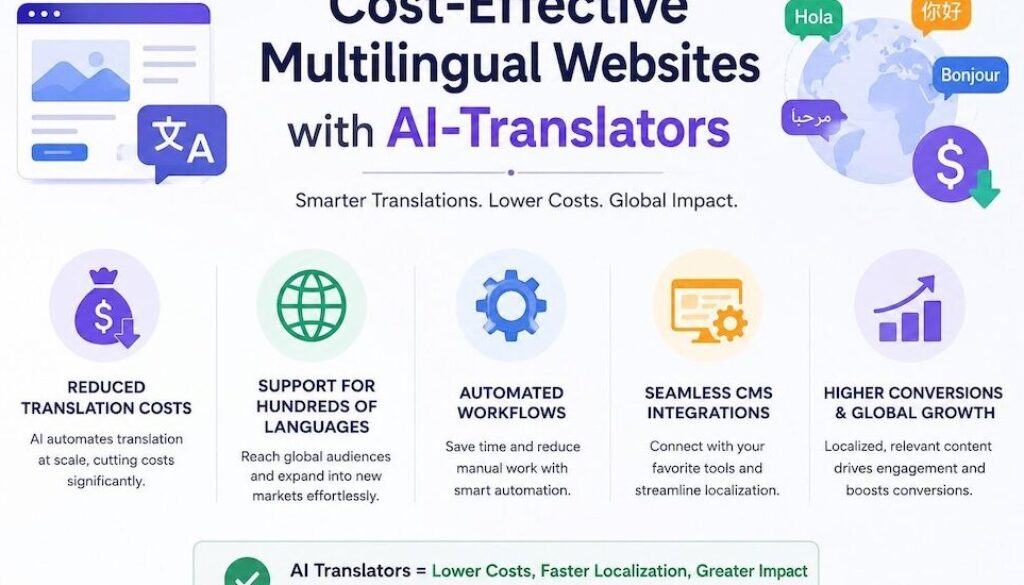
International businesses reach target geographic regions through regional website versions. Separate websites for each region add complexity and cost. So, bilingual and multilingual websites build relationships with audiences across the globe through localized content. This is where AI tools such as Smartcat have helped significantly in handling bulk data for hundreds of language translations.
Instead of hiring linguistic experts for every targeted language, a single platform professionally adapts content while ensuring brand voice consistency. But what truly encourages global brands to shift toward AI translators is affordable localization.
How do AI website translation agents provide cost-effective yet reliable services compared to traditional translation? In this comprehensive guide, learn all the factors behind the reduced costs of AI-based website translations.
Before choosing any translation workflow, it is important to understand that localization is more than converting words. It also includes tone, product terminology, page structure, search intent, metadata, and the user journey in each market. When these parts are handled in one connected workflow, the overall cost becomes much easier to control.
Why Affordability Matters for Multilingual Websites?
Global brands need content management and updates on a massive scale compared to local businesses. A small global business has to manage two to three regional variants on its website. Content creation requires multiple personnel, such as content creators, keyword researchers, editors, and SEO specialists.
In manual workload, linguistic expertise is required for each target language. Likewise, large-scale businesses may operate across hundreds of regions, so hiring a linguistic expert for each one adds high costs and also delays content management tasks.
Solution? AI website translation agents assist global brands in handling large volumes of content adaptation on the basis of monthly or yearly subscription fees. A single platform can manage all the required regional variations, and even for future potential markets.
This matters because localization costs do not stop after the first translation. Every new product launch, blog post, landing page change, seasonal campaign, and policy update has to be reflected across all language versions. The more markets a company enters, the more expensive manual coordination becomes. AI reduces this pressure by turning many repeat updates into one controlled process.
How Global Brands Save Operational Costs for Localized Webpages?
AI agents are much cheaper than human translators or traditional translation tools. With scalability, automated, centralized workflows, SEO-optimized output, minimal human resources, and real-time adaptation, they are cost-effective.
In simple terms, manual localization grows almost linearly with every new language. AI-assisted localization keeps more of the work reusable, so the cost of adding the next language or updating an old page is usually lower than starting again with a separate team.
Handling of Diverse Web Pages
AI translation agents can handle a diverse range of page categories on a global website. Landing pages, homepages, service pages, product categories, contact pages, about us pages, blog sections, etc., have their own specific format and structure. Advanced AI tools like Smartcat ensure format and tone consistency across regions.
Without any discrepancy in overall branding strategy, color schemes, fonts, background images, or other design aspects, they provide ready-to-publish localized content.
AI also helps when content is stored in reusable blocks, such as product descriptions, FAQs, banners, checkout messages, and help-center answers. Instead of translating every page as a fresh project, approved text can be reused across similar pages while still allowing local adjustments where needed.
Access to Hundreds of Languages
Website translation AI agents come with support for hundreds of regional languages. This allows businesses to not only serve existing target regions but also manage future market development strategies.
The same platform can scale localization support and content updates without significantly increasing operational costs.
Translation Memory and Brand Glossaries
One of the biggest cost-saving advantages is translation memory. Once a sentence, phrase, product description, or support answer has been approved, it can be reused whenever similar content appears again. This is helpful for websites with repeated product features, FAQs, legal notes, navigation labels, and checkout instructions.
Brand glossaries also protect important terms. Product names, slogans, feature names, industry words, and preferred phrases stay consistent across every language. Instead of paying reviewers to correct the same terminology again and again, the platform learns from approved choices and keeps future translations closer to the brand style.
Smooth Integrations with CMS Platforms
Global organizations rely on a variety of CMS tools for their workflows. Instead of managing translation tasks separately, advanced AI translators like Smartcat successfully integrate with third-party platforms. Global teams do not have to invest separately in content management and translation.
Centralized workflows handle the complete process, from upload to final editing of multilingual web pages. This allows the same team handling content management to execute localization tasks as well. That is why AI-based translation is highly scalable to meet the growing need for content localization in new markets.
Lower Engineering and Publishing Costs
Website localization is not only a writing task. Developers and content managers often spend hours copying text, fixing broken layouts, checking page structure, and publishing each language version. AI translation platforms with CMS integrations reduce this hidden cost by keeping translated content connected to the original website structure. This means fewer manual uploads, fewer formatting mistakes, and faster publishing.
Automated Workflows
AI-based tools improve workflow efficiency by handling repetitive tasks automatically. Automated workflows perform less important yet frequent tasks according to the initial instructions.
Manual handling of each and every task delays content updates and management. Not just time, hiring a workforce for repetitive tasks increases overall expenses.
For example, when a company updates a product description, pricing note, or call-to-action button, the change may need to appear across ten or twenty language versions. With a manual process, each update becomes a separate task. With AI-assisted localization, the update can move through the same workflow, keeping review time shorter and reducing the chance of missed pages.
AI Translation for Global Team Collaboration
AI translation agents provide seamless collaboration among global teams. They can work together on proofreading and review criteria for higher content consistency and time efficiency. Handling communication on multiple platforms adds complexity and confusion. The same AI model improves two-way communication in the same budget.
Successful global businesses consider Smartcat for its collaborative environment. Moreover, it gives access to subject matter experts from its marketplace who can review contextual mistakes for critical or sensitive data.
This is especially useful when a company wants speed without losing human judgment. AI can prepare the first version, keep terminology consistent, and highlight repeated content. Reviewers then spend their time on nuance, legal accuracy, cultural sensitivity, and conversion-focused wording instead of translating every sentence from zero.
International SEO
SEO strategies ensure a website appears in the top search results. For this purpose, SEO experts handle tasks such as keyword research, speed optimization, user experience, metadata management, etc. However, in manual translations, global businesses need separate SEO teams for each version, which increases overall expenses.
Advanced AI website translators implement SEO best practices during website localization. With localized keywords, hreflang implementation, and context consistency, they translate content while also supporting international SEO goals.
The cost benefit becomes stronger when SEO elements are handled together with the page content. Page titles, meta descriptions, image alt text, internal links, URL slugs, and local search intent should not be treated as afterthoughts. When these details are managed inside the localization workflow, businesses save time and avoid expensive SEO fixes after publication.
Higher Conversions with Real-Time Adaptation
AI website translation agents work more efficiently for real-time content localization. Updated content is automatically translated into all regional variants through automated workflows and machine learning models. This quick adaptation helps in effective communication. Users find the content relevant and easy to understand. So, high conversions eventually improve profit margins.
Better Budget Control for Future Markets
AI translation also makes future planning easier. A business can test a new market with a smaller set of localized pages before committing to a full regional team. If the market performs well, the same workflow can expand gradually. This reduces the risk of spending a large budget upfront on languages or regions that may not produce strong returns immediately.
Bottom Line
Are AI website translators cheaper than manual translations? Yes, by handling bulk data within a short time and completing repetitive tasks through automated workflows, AI significantly reduces localization costs. Subject matter experts only need to review drafts to eliminate contextual mistakes before publication. Instead of handling translation tasks manually, AI agents provide quick results so proofreaders can focus on linguistic details rather than translating from scratch.
Advanced AI website translation tools like Smartcat are serving international brands with cost-effective translation services. Along with localization, they ensure higher rankings with the best SEO practices. Most growth-focused teams choose localization and content translation platforms to eliminate unnecessary workflow pressure and reduce resource costs. That is why AI website translations are much cheaper than hiring linguistic experts.
A good approach is not to treat AI translation as a replacement for quality control. The smarter approach is to let AI handle the heavy first draft, repeated updates, and formatting work, while human reviewers focus on accuracy, nuance, and pages that matter most to customers. This balance gives businesses both speed and trust.
FAQs
Can an AI website translator work for international SEO?
Yes, advanced AI website translation agents work intelligently to create highly optimized regional versions for search engines. With localized keyword insertion, context consistency, metadata management, and hreflang implementation, they improve brand reach in targeted regions.
Why do global brands prefer real-time AI website translations?
Global enterprises prefer AI agents that work in real time for content localization. Web content is continually updated on websites to provide more information, promote, or build topical authority. Automated workflows continuously convert new content into various regional versions instantly without manual work. This improves workflow efficiency and provides higher coverage across all geographical areas.
Can AI website translators work independently without human input for contextual consistency?
The chances of linguistic mistakes are higher when the whole process is done entirely through AI. That is why international brands always review AI translations for different web pages to maintain brand voice across regional versions. Most AI tools use machine learning models in which future results improve based on previous editing history.
Which website pages should be localized first?
Businesses usually get the best return by starting with pages that directly affect discovery, trust, and sales. These include the homepage, main service pages, high-traffic landing pages, product pages, pricing pages, checkout pages, support pages, and key blog posts. Once these pages are stable, the same AI workflow can expand to older resources, knowledge-base articles, and campaign pages without creating a separate project for every market.
How do translation memory and glossaries reduce localization cost?
Translation memory stores approved sentences and phrases so they can be reused when similar content appears again. A glossary protects important brand terms, product names, industry words, and preferred phrases. Together, they reduce repeated translation work, shorten review time, and help different regional pages sound like they belong to the same brand.
What type of website content still needs closer human review?
AI can handle most standard website content quickly, but sensitive pages should always receive extra review. Legal notices, medical or financial claims, pricing details, refund policies, technical documentation, slogans, and culture-specific marketing messages need human judgment before they go live. This keeps the process affordable without risking accuracy or brand trust.