
Criminal Law VS Civil Law: How they are different?
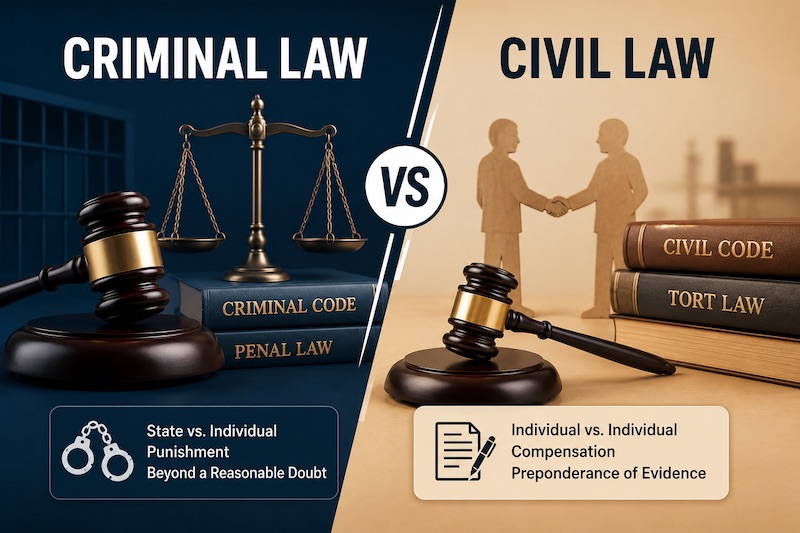
Criminal law and civil law deal with different types of legal problems. Criminal law covers acts that break laws made to protect the public. Civil law handles disputes over rights, money, property, injuries, and agreements.
The two areas can involve the same event. A person may face a criminal charge from the government and a civil lawsuit from someone who suffered harm. Each case follows its own rules and can reach a different result.
This guide explains the difference between criminal and civil law in clear language. It also covers who starts each case, how much proof the court requires, what outcomes may follow, and how one incident can create two separate legal actions.
Criminal Law vs. Civil Law: The Quick Answer
Criminal law deals with conduct that the government has made illegal. The government brings the case against the accused person. A conviction may lead to prison, jail, probation, a fine, community service, or another criminal penalty.
Civil law deals with disputes between people, businesses, organizations, and government bodies. The person who starts the lawsuit usually asks the court for money or a court order. Civil cases do not normally send someone to prison.
| Point | Criminal law | Civil law |
|---|---|---|
| Main concern | Breaking a criminal law | Harming a private right or legal interest |
| Who starts the case | A government prosecutor | A plaintiff such as a person or business |
| Person accused or sued | Defendant | Defendant |
| Required proof | Beyond a reasonable doubt | Usually a preponderance of the evidence |
| Final decision | Guilty or not guilty | Liable or not liable |
| Common outcome | Punishment or supervision | Compensation or a court order |
| Example | Prosecution for assault | Lawsuit for medical costs caused by the assault |
What Is Criminal Law?
Criminal law defines acts that society treats as crimes. These laws aim to protect people, property, public safety, and government systems.
Common criminal cases involve theft, assault, robbery, impaired driving, drug offenses, fraud, and homicide. The exact name and definition of each offense depend on local law.
A criminal case usually starts after police or another government agency investigates a reported offense. A prosecutor reviews the evidence. The prosecutor then decides whether the government should file charges.
The person who reports the crime does not control the prosecution. The government makes the charging decision. A victim may provide evidence, give a statement, or testify in court.
What does the prosecutor need to prove?
The prosecutor must prove every required part of the charge beyond a reasonable doubt. The defendant does not need to prove innocence.
The phrase “beyond a reasonable doubt” does not have a fixed percentage. It requires a high level of certainty based on the evidence. A reasonable doubt must come from reason rather than guesswork.
Possible criminal penalties
A court may impose one or more penalties after a guilty plea or conviction. The available sentence depends on the offense and local law.
- Jail or prison
- Probation or supervised release
- A criminal fine
- Community service
- Restitution paid to a victim
- Required treatment or education programs
- Loss of certain licenses or legal rights
A criminal record can also affect work, housing, travel, immigration status, and professional licensing. These effects may continue after the sentence ends.
What Is Civil Law?
Civil law handles legal disputes that do not involve a criminal prosecution. A person, company, organization, or government body may file a civil claim.
The party who starts the case is the plaintiff. The party facing the claim is the defendant. The plaintiff usually claims that the defendant caused a loss, broke an agreement, damaged property, or violated a legal right.
Common civil cases include:
- Personal injury claims
- Contract disputes
- Property disagreements
- Landlord and tenant cases
- Employment claims
- Consumer disputes
- Business lawsuits
- Family law cases
- Defamation claims
- Professional negligence cases
What does a civil plaintiff need to prove?
Most civil plaintiffs must prove their claims by a preponderance of the evidence. This means the claim appears more likely true than not true.
Some civil matters use a stronger standard called clear and convincing evidence. The correct standard depends on the claim and the law that controls it.
Common civil remedies
A civil court focuses on correcting harm or enforcing a legal right. It does not usually punish someone with imprisonment.
The court may award:
- Money for medical costs or property damage
- Payment for lost income
- Compensation for pain or other proven harm
- An order to stop certain conduct
- An order to complete a promised action
- A declaration that explains the parties’ legal rights
- Return of property
Some civil laws allow punitive damages. Courts use these damages in limited cases involving serious misconduct. Punitive damages still count as a civil remedy rather than a criminal sentence.
A Note About the Meaning of “Civil Law”
The term “civil law” can have two meanings.
In a criminal law comparison, civil law means non-criminal legal cases. These cases cover private rights, injuries, contracts, property, and similar disputes.
The same term can also describe a legal system built around written legal codes. Many countries use this civil-law tradition. That meaning differs from the criminal law vs. civil law comparison in this article.
The Main Differences Between Criminal and Civil Law
1. The cases protect different interests
Criminal law protects the public from conduct that lawmakers have classified as a crime. The case concerns more than the loss suffered by one person. The government treats the conduct as an offense against society.
Civil law protects private rights and legal interests. A civil case often focuses on a specific loss. That loss may involve an injury, unpaid debt, broken contract, damaged property, or interference with a legal right.
2. Different parties start the case
A prosecutor starts a criminal case for the government. The case name may show the government against the defendant. Examples include “State v. Smith” or “United States v. Smith.”
A plaintiff starts a civil lawsuit. The case name usually lists the plaintiff and defendant. An example would be “Taylor v. Smith.”
Government agencies can also file civil enforcement cases. A civil case does not always involve two private parties.
3. Criminal cases require stronger proof
The government carries a heavier burden in a criminal trial. It must prove guilt beyond a reasonable doubt.
A civil plaintiff usually needs to prove that a claim is more likely true than not. Lawyers call this a preponderance of the evidence.
The stronger criminal standard reflects the serious results of a conviction. A person may lose freedom and carry a criminal record.
4. The courts use different words for the result
A criminal court finds a defendant guilty or not guilty. A not-guilty verdict means the prosecutor did not prove the charge beyond a reasonable doubt. It does not always prove that the event never happened.
A civil court finds a defendant liable or not liable. Liability means legal responsibility for the claim.
5. The outcomes serve different purposes
A criminal sentence may punish conduct, protect the public, supervise the offender, or support rehabilitation.
A civil remedy usually aims to repair a loss or enforce a right. Money damages can help cover medical care, repairs, lost pay, or another proven cost. A judge may also order someone to stop an action or meet a legal duty.
6. The right to a lawyer differs
A criminal defendant may qualify for a court-appointed lawyer when the charge can lead to imprisonment and the defendant cannot afford legal help. The exact right depends on the type of case and local rules.
A party in a civil case usually must hire a lawyer or represent themselves. Some legal aid programs, laws, and court rules provide help in certain civil matters.
7. The court procedures differ
Criminal procedure includes special protections for the accused. These protections cover police searches, questioning, legal counsel, trial rights, and the government’s burden of proof.
Civil procedure focuses on claims, responses, document exchange, witness testimony, motions, settlement, and trial. Both parties may need to share relevant evidence during discovery.
Can the Same Act Lead to Criminal and Civil Cases?
Yes. One act can break a criminal law and cause private harm. The government may file a criminal charge while the injured person files a civil lawsuit.
The two cases remain separate. They may use some of the same evidence. They still have different parties, goals, proof standards, and outcomes.
Example: A traffic crash
A driver operates a vehicle while impaired and causes a crash. The government may prosecute the driver for impaired driving. An injured passenger may file a civil lawsuit for medical costs, lost income, and other losses.
The criminal case asks whether the driver committed a crime. The civil case asks whether the driver carries legal responsibility for the injuries.
Example: Physical assault
A person punches another person during an argument. A prosecutor may file an assault charge. The injured person may also sue for medical costs and other harm.
Example: Fraud
A business owner lies to customers and takes their money. The government may bring criminal fraud charges. The customers may file civil claims to recover their losses.
Example: Property taken without permission
The government may prosecute the act as theft. The owner may also bring a civil claim for the return or value of the property.
How a Criminal Case Usually Moves Through Court
Criminal procedures differ across jurisdictions. A case may include these stages:
- Investigation: Police or another agency collects evidence.
- Charging decision: A prosecutor reviews the case and decides whether to file charges.
- First court appearance: A judge explains the charge and considers release or detention.
- Plea: The defendant enters a plea such as guilty or not guilty.
- Pretrial stage: The lawyers review evidence and raise legal issues.
- Plea agreement or trial: The case may end through an agreement or move to trial.
- Verdict: A judge or jury decides whether the prosecutor proved the charge.
- Sentencing: The judge sets the penalty after a conviction or guilty plea.
Not every case reaches trial. Many criminal cases end through plea agreements, dismissals, or diversion programs.
How a Civil Case Usually Moves Through Court
A civil lawsuit often follows these steps:
- Complaint: The plaintiff files a document that explains the claim and requested remedy.
- Service: The defendant receives official notice of the lawsuit.
- Response: The defendant answers the allegations or raises a legal challenge.
- Discovery: The parties exchange documents and gather testimony.
- Motions: Either side may ask the judge to decide a legal issue.
- Settlement talks: The parties may try to resolve the dispute without trial.
- Trial: A judge or jury hears the evidence when no settlement occurs.
- Judgment: The court decides liability and awards any remedy.
Many civil cases end in settlement. A settlement gives the parties more control over the outcome. It can also reduce legal costs and avoid the risk of trial.
Plea Agreements and Civil Settlements Are Not the Same
A plea agreement belongs to a criminal case. The defendant agrees to plead guilty under stated terms. The prosecutor may reduce charges or recommend a sentence. A judge may still need to approve the agreement.
A settlement belongs to a civil dispute. The parties agree on terms that resolve the lawsuit. A settlement may include payment, return of property, changed conduct, or another promise.
A civil settlement does not create a criminal conviction. A criminal plea does not always pay every loss claimed by an injured person.
How Evidence Works in Each Type of Case
Both civil and criminal courts rely on evidence. Evidence may include documents, photographs, videos, physical objects, digital records, expert opinions, and witness testimony.
The rules for collecting and sharing that evidence differ.
Criminal prosecutors must follow constitutional and court rules when they gather evidence. A judge may exclude evidence obtained through an unlawful search. Prosecutors also have duties to provide certain information to the defense.
Civil discovery often allows broad requests for information connected to the dispute. Parties may request documents, send written questions, inspect property, and question witnesses under oath.
Courts can limit requests that seek irrelevant information or place an unfair burden on a party.
A Simple Criminal Case vs. Civil Case Example
Consider a shop owner who believes an employee took $2,000 from the cash register.
The possible criminal case
The shop owner reports the missing money. Police investigate. A prosecutor may file a theft charge when the evidence supports it.
The prosecutor must prove the charge beyond a reasonable doubt. A conviction may lead to probation, jail, a fine, restitution, or another sentence allowed by law.
The possible civil case
The shop owner may sue the employee to recover the missing $2,000 and other proven losses. The owner usually needs to show that the claim appears more likely true than not.
The civil court may order payment. It cannot convict the employee of theft or create a criminal sentence.
Why the results may differ
The prosecutor may decide that the evidence does not meet the criminal standard. The shop owner may still have enough proof for a civil claim.
The reverse can also occur. A criminal court may order restitution after a conviction. The victim may then decide that a separate civil lawsuit offers little practical benefit.
Important Legal Terms to Know
| Term | Plain meaning |
|---|---|
| Prosecutor | A government lawyer who brings a criminal case. |
| Plaintiff | The person or organization that starts a civil lawsuit. |
| Defendant | The person accused in a criminal case or sued in a civil case. |
| Conviction | A finding of guilt or a guilty plea in a criminal case. |
| Liability | Legal responsibility in a civil case. |
| Damages | Money awarded for a proven civil loss. |
| Restitution | Payment ordered in a criminal case to cover certain victim losses. |
| Injunction | A civil court order that requires or stops an action. |
| Acquittal | A not-guilty result in a criminal case. |
| Judgment | The court’s final decision in a civil lawsuit. |
How to Tell Whether a Case Is Criminal or Civil
Look at who started the case and what result that party wants.
A government prosecutor asking for a conviction points to a criminal case. A person or business asking for compensation or a court order points to a civil case.
The case documents also provide clues. Criminal filings may use terms such as charge, indictment, plea, conviction, or sentence. Civil filings may use terms such as complaint, claim, damages, liability, or judgment.
The presence of a victim does not make a case civil. The government can prosecute conduct that harmed a specific person. The same victim may also bring a separate lawsuit.
Frequently Asked Questions
What is the biggest difference between criminal and civil law?
Criminal law deals with crimes prosecuted by the government. Civil law deals with legal disputes and claims for money or court orders.
Can a civil case send someone to prison?
A normal civil judgment does not send a defendant to prison. A person may face separate consequences for disobeying a court order. Criminal charges may also arise from the same conduct.
Which type of case requires more proof?
A criminal conviction requires stronger proof. The prosecutor must prove guilt beyond a reasonable doubt. A civil plaintiff usually needs to prove that a claim is more likely true than not.
Can someone face both criminal and civil cases?
Yes. One act can break a criminal law and cause a private loss. The government may prosecute the crime while the injured party files a civil lawsuit.
Who files a criminal case?
A government prosecutor files or pursues a criminal case. A victim can report the event and provide evidence, but the government controls the prosecution.
What happens when a person loses a civil case?
The court may order the person to pay damages, return property, complete an obligation, or stop certain conduct. The exact remedy depends on the claim.
Can a person win a civil case after a criminal acquittal?
Yes. The civil case uses a lower proof standard and serves a different purpose. The outcome depends on the evidence and the law that applies.
Criminal Law vs. Civil Law at a Glance
Criminal law allows the government to prosecute conduct that violates a criminal statute. The prosecutor must prove guilt beyond a reasonable doubt. A conviction may lead to loss of freedom, supervision, fines, or other penalties.
Civil law allows people and organizations to protect their rights or recover proven losses. A plaintiff usually carries a lower burden of proof. The court may award money or issue an order.
The same event can create both kinds of cases. The criminal court decides guilt. The civil court decides liability. Each court follows its own rules and reaches its own result.
Legal information notice: This content provides general educational information. It does not give legal advice. A licensed lawyer in the correct location can explain how local laws apply to a specific dispute or criminal charge.