Why Your Brain Thinks You’re a Better Driver Than You ACTUALLY Are?
Are You a Good Driver?
You’re probably better than most, right? You haven’t had an accident in years, and the commute always goes smoothly.
That must be skill, and not everyone can say that for themselves.
But… Are you really such a great driver, or are you just super confident?
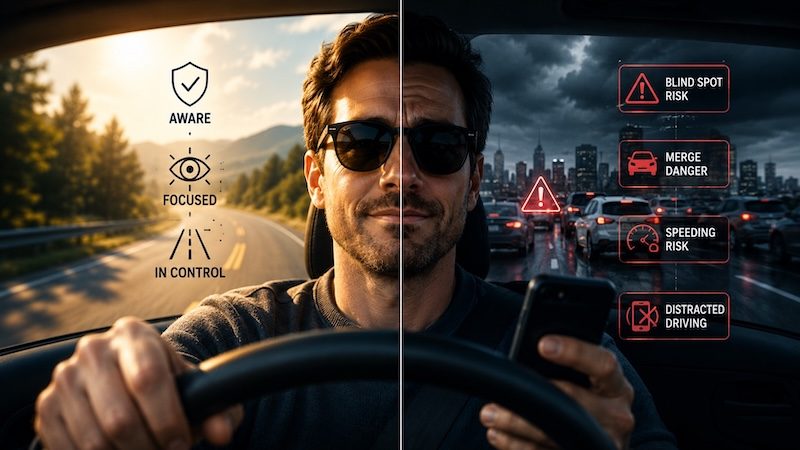
Lots of people tend to feel safe while driving because it feels so familiar. And familiar equals safe. Your brain can’t really tell the difference between feeling safe and being safe. You get better at most skills the more you practice, but believe it or not, driving isn’t one of them. And the better you think you are, the less attention you pay to what’s happening on the road.
So, are you truly a good driver or are you just too confident for your own good?
Why Experience Alone Can’t Make You a Better Driver
Having 10 or 20 years of driving experience doesn’t mean you’re a good driver, although many people think that experience means expertise. And that makes sense, especially if you haven’t had a lot of accidents.
But the problem here is that your brain hasn’t used those 10 or 20 years to become more careful; it just became more comfortable.
And being too comfortable on the road isn’t really a good thing.
Here’s how this (usually) goes.
Every time you’ve merged onto the same highway for the 1000th time, or you took a turn you’ve taken many times before, your brain took that as proof that what you’re doing is safe because nothing bad happened. It doesn’t matter that you didn’t check the blind spot or that you cut it too close on the merge.
Things turned out okay, and the only thing your brain cares about is the outcome.
No crash = no problem. If you do the same thing over and over and everything works out fine, your brain stops seeing any risk in it. This is called overconfidence bias, and it’s a fancy way of saying that your brain has gotten lazy and assumes that, if things were fine before, they’ll continue to be fine.
There are 3 things that go into this: experience, skill, and making decisions.
Experience is just time, and skill is about how you handle the car itself (e.g., steering smoothly, braking just when you need to, etc.).
Neither of these is what keeps you alive.
What keeps you in one piece is making good decisions.
That would be things like reading the road, watching what the other drivers are doing, knowing when to back off, and so on. You could have both skill and experience and STILL be a lousy driver if you make lousy decisions and don’t pay attention.
If you’re driving on an empty road somewhere in the countryside, you can afford to relax a little.
But let’s say you’re driving in a huge, HUGE city like Chicago. Chicago is full of vehicles, and the traffic is absolutely wild. If you wander off and get too comfortable, you may find yourself having to look for a head-on truck collision attorney in Chicago because an accident here, with so many parties involved, gets really complicated really fast.
What Makes You Think You’re a Better Driver Than You Are
Feel superior when you’re behind the wheel?
Here’s why.
Routine Makes Your Mind Go on Autopilot
Your brain loves routines because routines save energy.
So, when you drive the same way every day, the brain stops being super vigilant and turns it over to a system that runs on autopilot. The turns, the lights, the exits – you do all of these without thinking much about them.
What this does is it frees up mental space for other things. It’s like a disc clean-up feature on your computer. But yeah, it also means that you’re not exactly fully present while you’re doing the actual driving.
Your focus, your concentration, your alertness, they’re dialed down a bit. And when it comes to you reacting to a potentially dangerous situation, that’s not exactly a good thing.
The More You Get Away with Bad Habits, the More Confident You Get
There’s a stop sign, but you only slow down a bit because there’s obviously no one coming. The green light starts blinking, turning to yellow, but you hit the gas because it’s still not red and you don’t want to be late. You check that notification you just got on your phone because there’s no traffic on the road and you’ve got the thing under control anyway.
Sure, you’re not delusional. You KNOW you shouldn’t be doing this type of behavior while you’re driving. This is how accidents happen. But, it’s not that big of a deal because you’ve never been in an accident. This means you’re doing something differently. You’re better at it than other people.
At least that’s what you keep telling yourself.
That’s pretty much why your brain doesn’t see this type of behavior as risky, and over time, bad habits become normal.
Near Misses Don’t Change How You Judge Yourself
Let’s say you brake too late and barely avoid an accident.
What do you do next?
Well, after the adrenaline subsides a bit and the shock passes, you analyze. And of course – it’s NOT your fault. The other ‘stupid’ driver was at fault here. OBVIOUSLY! No, it was the weather. There must be something wrong with the traffic light, because it turned red too quickly.
And sure, avoiding accountability is far too common in these types of situations, but it’s also a way that we protect ourselves. Irrational, but yes, we humans do that. No one wants to be in the position where they’re the ones to blame, where fingers are pointed their way.
It’s uncomfortable. We don’t want to deal with that. So our natural instinct is to deflect.
And our brain helps us. It rewrites the narrative in a way that makes US the good guy, while the perpetrator is someone (or something) else.
And even though a learning moment was presented to you just now, you’ve missed it. It went well over your head.
And now, you’re destined to repeat it.
Conclusion
So, does all this mean you’re a bad driver? Possibly. Who knows!
If you’ve recognized yourself in this article more times than you’d want to admit, then there’s a good chance you’re not as careful as you should be.
But don’t feel (too) bad. Your brain’s just doing its job, but perhaps you shouldn’t believe it too much.
That little voice in the back of our heads – our mind, our brain, our ego, it doesn’t really matter WHAT it is – what matters is what it’s doing. It’ll tell you that you’re an excellent driver, even though you’re semi-napping behind the wheel.
So perhaps now’s the time to stop listening to that little voice while you’re driving, and it’s time for you to start paying attention to what’s happening on the actual road.